



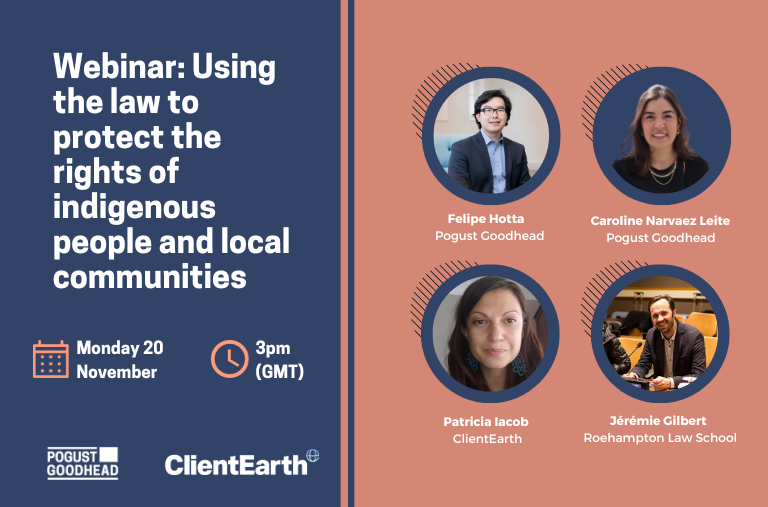
On 20 November, Pogust Goodhead hosted a discussion exploring how the law can be used to fight for Indigenous rights. Joined by ClientEarth and Roehampton Law School, we discussed how organizations are working to protect Indigenous people, local communities and the environment.
Championing Indigenous rights
As the world faces growing demand for critical minerals and mining, for meat and agriculture, for forests and wood – our discussion addressed how we can protect the rights of people living in those lands.
Covering both the application of and potential gaps in the law, the conversation featured ongoing cases in Brazil, Australia, and Gabon.
The event was moderated by Felipe Hotta, Partner at Pogust Goodhead. Felipe led the discussion to find out the main challenges and obstacles that organizations have faced in advocating for the protection of Indigenous rights.
Empowering Indigenous voices
Caroline Narvaez Leite, Legal Director at Pogust Goodhead, has extensive expertise in civil and commercial disputes. She has a specific focus on representing victims of environmental disasters and advocating for affected Indigenous communities.
Caroline spoke about how Pogust Goodhead’s approach differs from the standard paternalistic view of working with Indigenous communities. “We make sure that they are heard, and they participate in the process of decision making.”
Ecosystem governance
Patricia Iacob, Law and Policy Advisor at ClientEarth, is dedicated to empowering forest-dependent communities in Gabon. She highlighted the critical importance of preserving the country’s crucial forests.
“Our approach in Africa isn’t to lead litigation cases in national courts. We have a long-term vision of multi-stakeholder, transparent, and fair ecosystem governance. We aim to increase the legal capacity of local actors, NGOs, Indigenous peoples, local communities, and governments to increase the credibility of their voice in national governance decisions.”
Enforcing positive change
Jérémie Gilbert, an internationally recognized expert in human rights law and Professor at Roehampton Law School, also gave insights into his career.
“Something I’ve learned really over the last 20 years is Indigenous peoples are the victim of conservation in many places, meaning top-down imposed conservation.”
He went on to discuss the practicalities of how we can enforce positive change in the countries in which we work: “You need to work on the legal development of the country. Litigation is only used as a wedge into the legal system. You have to be a litigator, a policy advocate and you need to engage in community empowerment at the same time. It’s not easy – lawyers need to be very technical but at the same time they need to be on the ground and doing that.”