


Historical ruling holds the mining giant liable for the Mariana dam disaster under Brazilian environmental law and the Brazilian Civil Code. The Court rejects BHP’s arguments on limitation, confirming that all English claimants are in time and that claims will remain open at least until September 2029. The judgment also confirms that municipalities can pursue their claims in England and clarifies the effect of waivers signed by victims who joined compensation schemes.
Hundreds of thousands of victims of Brazil’s worst environmental disaster have today secured historical victory over mining giant BHP as the High Court rules that the company is responsible for the collapse of the Fundão tailings dam in Mariana, Minas Gerais, Brazil in 2015.
The judgment in favour of the victims marks the first time that any of the companies behind the dam collapse have been held to account – a decade after the disaster killed 19 people and shattered the lives of millions more.
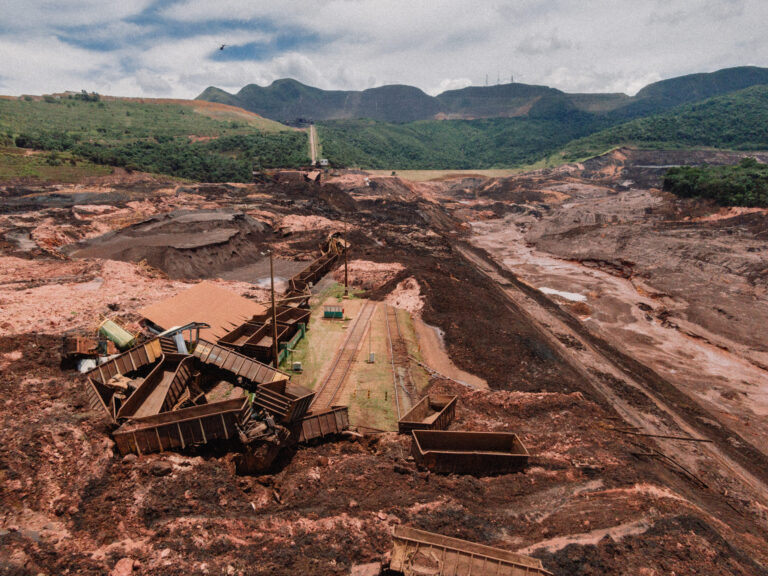
The collapse remains the most devasting environmental tragedy in Brazil’s history. Over 40 million tonnes of toxic waste surged across the landscape, the devastating effects of which endure to this day.
Led by international law firm Pogust Goodhead, this unprecedented group claim has seen hundreds of thousands of victims unite in the fight for the justice, recognition and compensation that BHP has spent years fighting to avoid.
A landmark decision
Indirect polluter – In a detailed ruling, The Honourable Mrs Justice O’Farrell DBE found BHP both as a polluter under the Brazilian Environmental Law and based on fault under the Brazilian Civil Code. The Judge confirmed that anyone directly or indirectly responsible for a polluting activity is treated as a polluter – including those who control, finance, participate in or profit from the activity, or who create the risk it poses.
Negligence and imprudence – The Court held that the dam collapse was caused by BHP’s negligence, imprudence and/or lack of skill. The Judge found “overwhelming” pre-collapse evidence that the dam was unstable and that the risk of liquefaction and collapse was foreseeable and preventable. BHP knew of serious defects and clear warning signs from at least August 2014, yet failed to implement adequate remedial measures and instead continued to raise the dam, causing the collapse.
Control and operation – The evidence presented to the court showed that, contrary to what BHP had claimed for a decade, the company, together with Vale, controlled and operated Samarco, were its “directing mind”, were involved in its operations from strategic decisions to day-to-day matters, had assumed responsibility for managing the dam’s risks, and had substantially invested in and profited from Samarco as a key asset.
No time-barrier – The Court rejected the company’s attempts to narrow its responsibility and concluded that criminal proceedings over the dam collapse postponed the start of the limitation period until at least September 2024. The Judge held that victims can bring claims against BHP until at least September 2029, with some potentially benefiting from even longer deadlines.
Standing of municipalities – The judgment confirms that Brazilian municipalities are entitled to pursue their claims in England. Thirty-one municipalities are currently part of the action and, despite their standing being challenged by the mining companies before Brazil’s Supreme Court (STF), the English Court has now ruled that they can continue litigating.
Waivers – The Court held that the scope of any waiver signed by individuals who joined compensation schemes via Renova or the Repactuation depends on the specific terms and circumstances of each agreement, applying Civil Code rules on contractual interpretation. It also found that the Consumer Defence Code does not apply to these agreements.
The pursue of justice
This ruling is the culmination of a herculean cross-continental effort between Brazilian and British lawyers representing hundreds of thousands of victims. It stands as a milestone for those affected in their decade-long struggle for accountability.
“We had to cross the Atlantic Ocean and go to England to finally see a mining company held to account. This victory gives hope to all of us who were affected – especially the families of the deceased victims and the more than 80 residents of Bento Rodrigues who died without receiving their new homes,” commented Mônica dos Santos, a member of the Commission for Those Affected by the Fundão Dam and the residents’ group Loucos Pelo Bento (‘Crazy For Bento’).
Gelvana Rodrigues, whose 7-year-old son was swept away and killed by the mudslide in Bento Rodrigues, celebrated the decision: “Finally, justice has begun to be served, and those responsible have been held accountable for destroying our lives. I promised myself that I would not rest until those responsible were punished for the death of my son Thiago. The judge’s decision shows what we have been saying for the last 10 years: it was not an accident, and BHP must take responsibility for its actions.”
For lawyers, the decision demonstrates the need for large corporations to be held accountable for their actions.
“Today’s ruling delivers long-overdue justice to the thousands whose lives were torn apart, and it sends an unmistakable message to multinational companies around the world: You cannot disregard your duty of care and walk away from the devastation you caused. Liability has been established. BHP is now compelled to answer for its actions and pay what is owed,” says Pogust Goodhead CEO Alicia Alinia.
Next steps
With this judgment, the case now proceeds to the second stage of the proceedings, during which the court will assess the damages and losses suffered by the victims as a result of the dam collapse. The court has listed a Case Management Conference (CMC) on 17 and 18th December 2025 and the trial in October 2026. The decision may be subject to appeal by BHP if permitted by the court. To do so, BHP will have 21 days after the ruling is announced to seek permission to appeal from the court.