




Some 200,000 victims of the Mariana Dam environmental disaster in Brazil are today celebrating having been granted permission to reopen their £5bn case against mining giant BHP after a landmark English court ruling.
The case against BHP had been struck out last year but, in a judgment published today (27 July) a panel of judges reopened the case and granted permission to appeal.
The judgment concludes: “Whilst we fully understand the considerations that led the judge to his conclusion that the claim should be struck out, we nevertheless believe that the appeal has a real prospect of success.”
Landmark ruling
The ruling allows the case to be reopened under exceptional appeals legislation (CPR 52.30), ‘in order to avoid real injustice’, after a High Court judge refused jurisdiction in November 2020, a decision affirmed in an initial appeal ruling in March 2021.
Tom Goodhead, Managing Partner at Pogust Goodhead who have been battling for the claimants, said: “This is a monumental judgement and our clients feel like this is the first time that any judges have recognised the importance of this case.
“After the case was struck out in March there was a view that this was the end of the road for the victims. So it is incredibly rewarding for us to be able to tell them that we still believe they will see satisfactory redress through the English courts.
“We look to recent precedent, including the Supreme Court’s 2019 decision that Vedanta did have a case to answer in England over their responsibilities to Zambian villagers affected by pollution caused by one of their companies, as well as the ruling that Shell can be sued in English courts by Nigerian communities affected by the company’s operations there.”
The judgment following an oral hearing at the Royal Courts of Justice, London, on 22 June, a panel of judges – comprised of Master of the Rolls Sir Geoffrey Vos, Lord Justice Underhill (Vice-President of the Court of Appeal) and Lady Justice Carr – ruled that the case should be reopened, and that it should be heard before the Court of Appeal, after initially being dismissed as ‘unmanageable’ by a High Court judge.
The claimants believe that upon appeal they can establish jurisdiction in England against BHP Group Plc, a company domiciled in England, and BHP Group Limited, a company domiciled in Australia.
Dates for the claimants’ case to be heard by the Court of Appeal are yet to be set.
The Mariana Dam Disaster
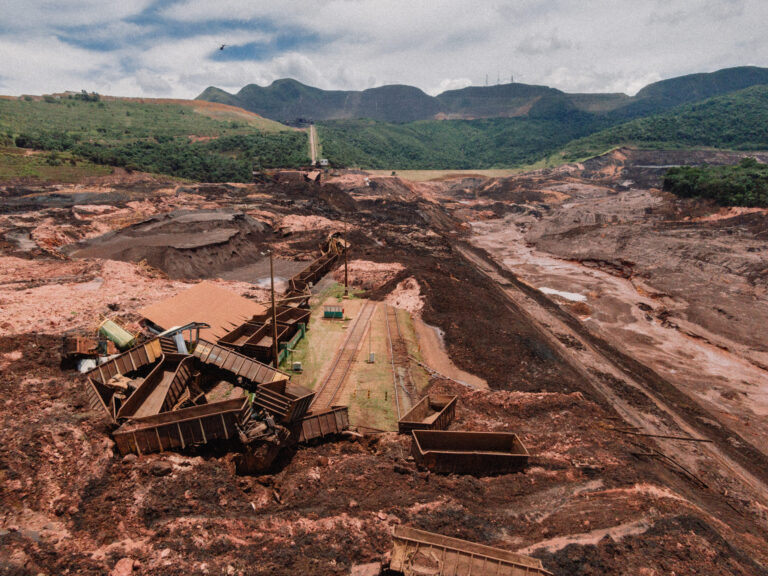
The case against BHP relates to the company’s ‘ultimate responsibility’ for the 2015 disaster, the worst environmental crisis in Brazilian history, in which the Fundão iron-ore tailings dam near Mariana collapsed, unleashing a torrent of toxic sludge destroying communities, contaminating hundreds of miles of waterways and killing 19 people.
BHP, one of the parent companies of dam operator Samarco, is being sued for an estimated £5billion in damages by around 200,000 individuals, 25 Brazilian municipal governments, 530 businesses, a Catholic archdiocese and members of the Krenak indigenous community in the case, brought on the claimants’ behalf by international law firm Pogust Goodhead.
The claimants argue that redress achieved in Brazil has been inadequate, with BHP largely protected from legal consequences to date, and that they have the right to pursue the case against BHP in England, where BHP is domiciled.
Frederico de Assis Faria, Attorney General of Mariana, an area badly affected by the disaster, welcomed the judges’ decision.
“Nearly six years on, we still live with the effects of what happened,” said Faria.
“This case represents the rights of every affected individual. BHP’s empty redress efforts in the national territory have been very disappointing and the reopening of the action in the English court gives us an opportunity for real justice.”
UN Special Rapporteur
The contentions of the claimants are echoed by UN Special Rapporteur Baskut Tuncak, whose 2020 report alleged that those responsible for the disaster had failed to effectively support or compensate victims, specifically highlighting the inadequacies of the Renova Foundation, the remedial scheme administered by the miners.
Tuncak wrote: “In the aftermath of the disaster, BHP and [partners] Vale rushed to create the Renova Foundation to provide the affected communities an effective remedy. Unfortunately, the true purpose of the Renova Foundation appears to limit liability of BHP and Vale, rather than provide any semblance of an effective remedy. Institutional shortcomings are well documented in literature and litigation. Today, none of 42 projects are on track.”