


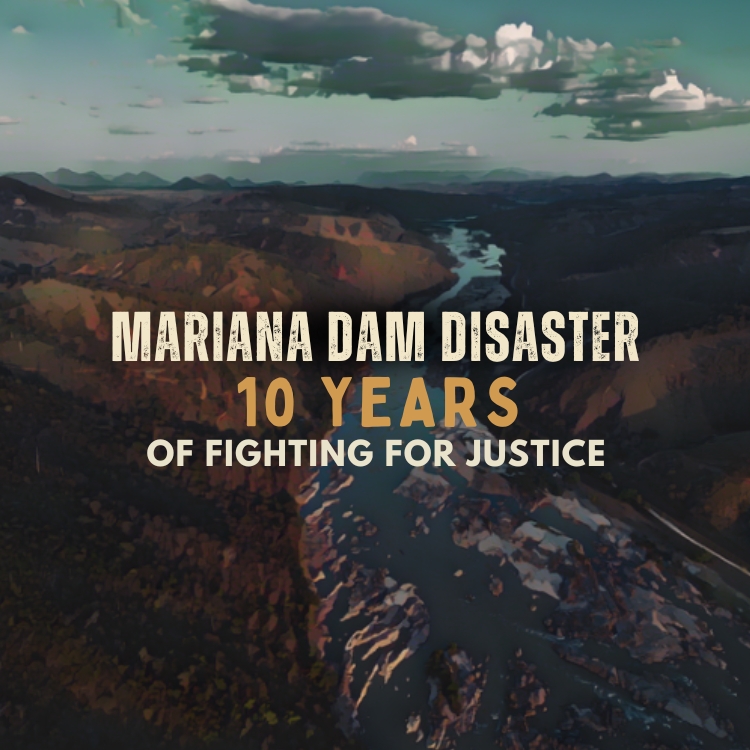
London, UK – A decade after the catastrophic collapse of the Fundão dam in Mariana, Brazil – which claimed 19 lives, impacted the livelihoods of over two million people, and polluted more than 700 km of the Rio Doce river – hundreds of thousands of victims are still waiting for justice. That justice may finally come, when the High Court of Justice in England and Wales delivers its landmark liability judgment in the case against BHP.
On 5 November 2015, the Fundão iron ore tailings dam, operated by Samarco – a joint venture between Australian mining giant BHP and Brazil’s Vale – burst, releasing over 44.5 million cubic metres of toxic sludge across the states of Minas Gerais, Espírito Santo and Bahia. The affected area is larger than England’s territory.
It remains the worst environmental disaster in Brazil’s history, as recent research shows that environmental and health impacts continue to devastate the region – affecting water quality, ecosystems, and the well-being of entire communities ten years later.
Fight for justice
Over 620,000 victims, represented by international law firm Pogust Goodhead, are seeking fair compensation and accountability for the collapse of the Fundão dam through legal proceedings in the English High Court. Filed in 2018 against BHP, the case has become the largest environmental group action in English legal history, marking a pivotal moment for corporate accountability and environmental justice.
Victims and campaigners hope that the 10th anniversary will serve as a powerful reminder that global corporations must be held accountable for the long-term consequences of their actions.
Alicia Alinia, CEO at Pogust Goodhead stated:
“What happened on 5 November 2015 was not an accident – it was a crime that continues to devastate lives, communities, and ecosystems a decade later. It is unacceptable that so many victims are still fighting for the justice and compensation they deserve.
As lawyers, our mission is first and foremost to secure justice and fair compensation for our clients. But judgments that hold powerful corporations to account can achieve far more – they can drive systemic change, shaping how companies act, how boards make decisions, and how investors demand responsibility.
A positive ruling against BHP would send a powerful message to corporations worldwide: profit can never come at the expense of human life or the environment.”
Alinne Ribeiro, widow of Samuel Vieira Albino, said:
“My husband worked at the dam. He was killed by the disaster, and his body was only found a week later 100 km away from the dam site. Following the collapse, I was left alone to care for our children, including our two-year-old daughter. I am not alone in believing that we will win this fight and that the world will see that they were really the responsible ones. I want this trial to set an example so that no one else has to experience what I did as a wife and mother. This judgment will bring justice and ensure that this type of crime is never allowed to happen again.”
The legal proceedings
– November 2018: Claim filed in the English courts
– July 2022: English courts rule that they have jurisdiction to hear the case
– October 2024: Start of BHP liability trial
– March 2025: End of BHP liability trial
– November/December 2025: Expected judgment
– October 2026: Start of damages trial
The trial to determine BHP’s liability for the collapse lasted 13 weeks, from October 2024 to March 2025. The court heard witnesses and legal and technical experts on the claims of BHP’s liability and facts associated with it such as their control and benefits over the polluting activities
and benefits from the risky activities. Seven witnesses appointed by BHP and 8 experts, being 4 appointed by the claimants and 4 by the defendants were cross examined and the evidence was clear: the disaster could have been avoided.
The case is now awaiting judgment from Mrs Justice Finola O’Farrell, at the Technology and Construction Court. In parallel, PG works on the second stage of the proceedings, scheduled for October 2026, which will focus on establishing the full extent of the damages caused by the
dam collapse and the causal link between the disaster and the losses suffered by those affected.
Media contact: commsteam@pogustgoodhead.com